
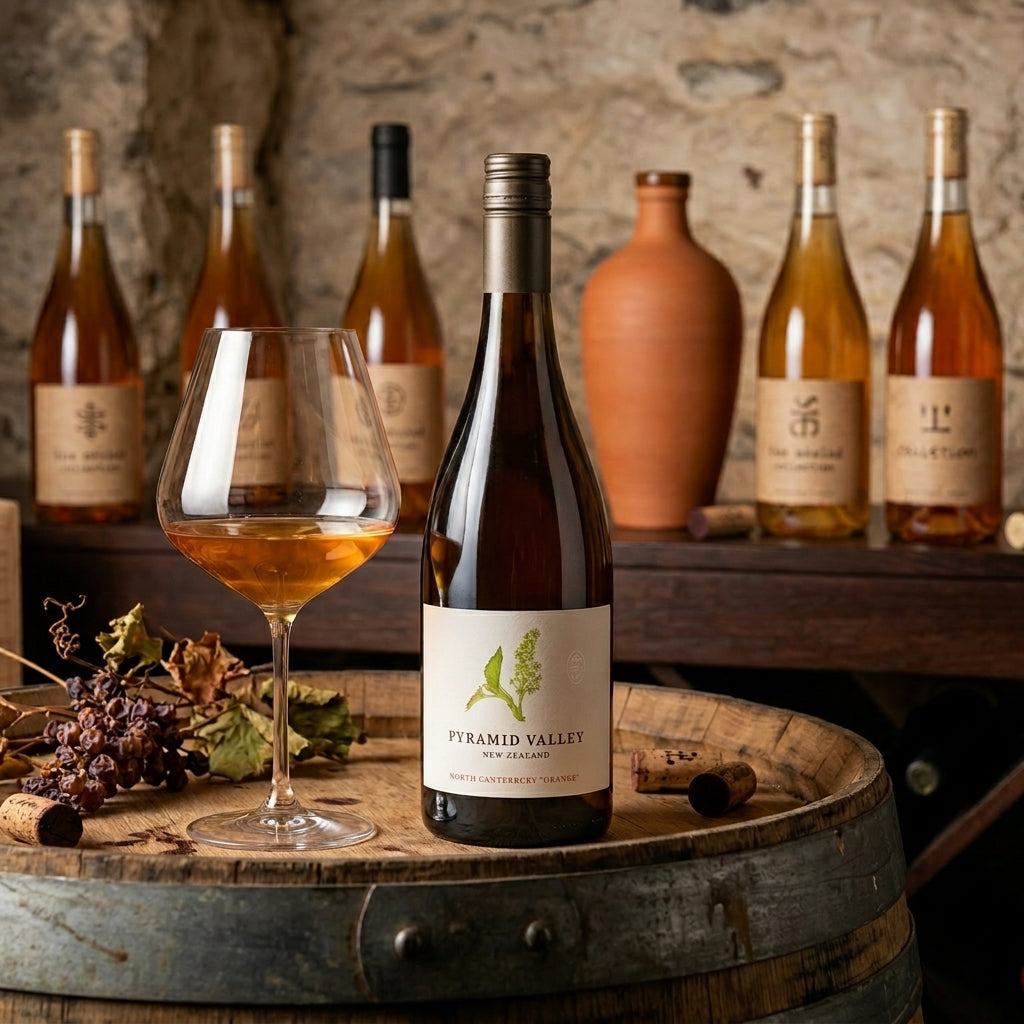
The ancient winemaking technique taking over wine lists — and dividing drinkers everywhere.
Walk into any self-respecting wine bar these days — from Singapore's Tanjong Pagar to London's Soho, Copenhagen to Cape Town — and you'll find at least one bottle on the list with an amber-hued pour and a name that sounds like it was coined by a forager: skin-contact, amber wine, ramato. But most people know it simply as orange wine. And most people, the first time they encounter it, have roughly the same question: is this actually wine?
The answer is yes. Emphatically, anciently, and fascinatingly yes.
What exactly is it?
Orange wine isn't made from oranges. The colour — which ranges from pale golden to deep burnished amber, even a bruised copper — comes from an unusual winemaking decision: leaving white grapes in contact with their skins during fermentation, sometimes for days, sometimes for months.
In conventional white winemaking, the juice is separated from the skins almost immediately after pressing. The skins are discarded. What you're left with is something pale, clean, and fruit-forward. Orange wine flips that logic. By keeping the skins in contact with the fermenting juice, winemakers extract tannins, texture, phenolic compounds, and colour — everything that normally defines red wine — but from a white grape. The result is something genuinely in-between: not white, not red, not rosé. A fourth colour.
"Orange wine sits at the crossroads of ancient tradition and modern natural wine culture — and that tension is exactly what makes it so compelling."
This is not a new idea
Here's what surprises most people: orange wine is arguably the oldest method of winemaking on earth. The technique traces back at least 8,000 years to the Caucasus region — what is now Georgia — where families fermented whole clusters of grapes, skins and all, in large buried clay vessels called qvevri. No temperature control, no additives, no intervention. Just grapes, time, and stone.
For millennia, this was simply how wine was made. The split between "white" and "red" winemaking is, historically speaking, a fairly recent innovation. What we now call orange wine is closer to the original.
The modern revival
Orange wine disappeared from most of the world for centuries, replaced by cleaner, more predictable winemaking technology. Its modern rediscovery is largely credited to Josko Gravner, a Friulian winemaker in northeastern Italy, who in the early 2000s abandoned conventional white winemaking to revive skin-contact fermentation — partly inspired by a trip to Georgia. Around the same time, Slovenian producers across the border were doing something similar.
What began as a fringe obsession among natural wine devotees gradually seeped into the mainstream. Today, orange wines are made on every serious wine-producing continent, from cool-climate Slovenia to sun-baked South Africa, from Australia's McLaren Vale to the verdant hills of Sonoma. Georgian qvevri wines hold UNESCO Intangible Cultural Heritage status. Sommeliers who once smirked are now dedicating entire sections of their wine lists to the category.
What does it actually taste like?
This is where people either lean in or lean out. Orange wine tastes like nothing else. Expect dried apricot and bruised apple, walnut and hazelnut, chamomile, quince, sometimes a whiff of beeswax. The texture is different too — fuller, grippier than a white wine, with tannins that coat the palate. There's often an oxidative quality, a Sherry-like nuttiness, that can feel strange on first encounter.
Longer skin-contact wines tend toward the wild and funky end — think forest floor, sourdough, fermented tea. Shorter-contact versions are gentler, more approachable, closer to an amber-tinted white. The range within the category is enormous. Comparing a lightly macerated Pinot Grigio from Friuli to a six-month qvevri-fermented Rkatsiteli from Kakheti is a bit like comparing a Beaujolais to a Barolo — both red, wildly different experiences.
"The tannins in orange wine change everything. They're the reason it pairs so effortlessly with dishes that would overwhelm a conventional white."
Why the hype, why now?
Several forces converged to lift orange wine from cult curio to genuine trend. The natural wine movement created an audience hungry for authenticity, provenance, and wines with a story. Skin-contact wines fit that perfectly — they're often low-intervention, minimal-sulphur, expressive of terroir in ways that polished commercial whites aren't. They photograph beautifully, that amber glow looking extraordinary against white linen or a marble bar top. Instagram didn't create orange wine, but it certainly didn't hurt.
There's also a culinary dimension. As restaurants worldwide leaned harder into fermented, umami-forward, and spice-inflected cooking — Korean, Japanese, Levantine, Southeast Asian — sommeliers found that orange wines, with their tannin structure and oxidative complexity, paired in ways conventional whites couldn't. The food world changed, and orange wine was ready to meet it.
And then there's simply the fact that drinkers are bored. Wine culture spent decades rewarding safe, predictable, fruit-driven wines that hit familiar comfort notes. A generation of drinkers who grew up eating adventurously wants to drink adventurously too.
Is it for everyone?
Honestly? Not immediately. Orange wine is an acquired taste, and there's no shame in admitting that the first glass was bewildering. The funkiness can be confronting. The tannins feel wrong if you're expecting a Sauvignon Blanc. The colour itself trips people up — there's something cognitively dissonant about pouring something that looks like apple juice from a wine bottle.
But the people who fall for it tend to fall hard. There's a depth and complexity to good orange wine that's genuinely unlike anything else in the glass. It rewards patience. It rewards adventurousness. It rewards drinking with food, preferably a lot of it, preferably something with a bit of salt and ferment and spice.
The hype isn't hollow. It's the sound of drinkers discovering something that's simultaneously brand new and 8,000 years old — and realising the glass they're holding contains a little bit of that whole strange, amber history.
Shop our Orange Wines