
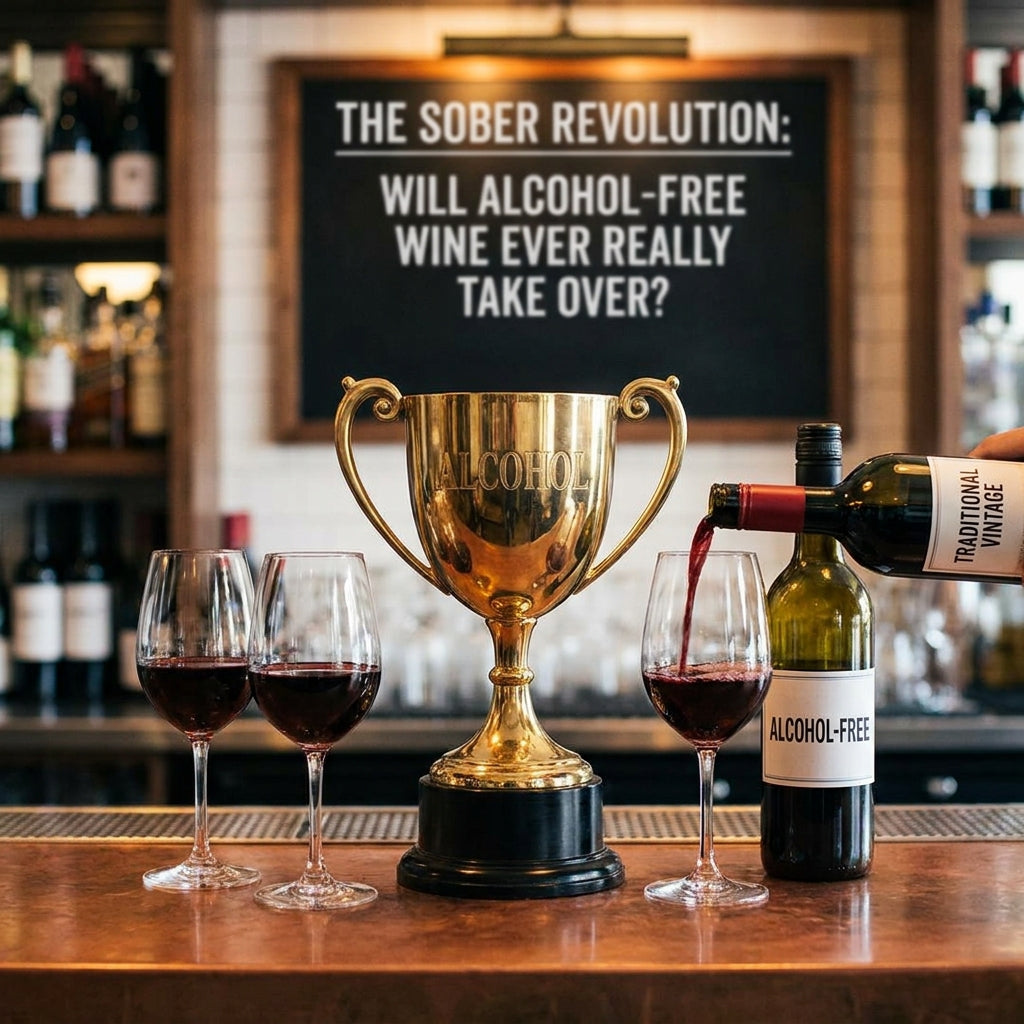
Something has shifted in the drinks aisle. Where once the non-alcoholic section meant a dusty bottle of grape juice next to the sparkling water, there are now shelves of dealcoholised Sauvignon Blanc, zero-ABV Shiraz, and alcohol-removed sparkling wine bearing the names of some of the world’s most respected producers. LVMH has backed an alcohol-free Champagne alternative. Penfolds has an NA range. Treasury Wine Estates launched an alcohol-free Squealing Pig. The message from the big players is clear: this is not a passing fad.
But is it actually a threat to wine? And will it ever — really — take over? The honest answer is more nuanced than either the evangelists or the sceptics would have you believe.
The numbers are real — but keep them in context
Let’s start with what the data actually says. The global non-alcoholic wine market was valued at around $2.5 billion in 2025 and is projected to roughly double by 2033, growing at a compound annual rate of around 10%. In the US alone, the broader no/low alcohol category passed $1 billion in off-premise retail in 2025, growing at 22% year-on-year. These are not trivial numbers.
But context matters. Non-alcoholic wine currently accounts for less than 1% of total global alcohol sales. The entire no/low category — beer, wine, and spirits combined — represents about 0.8% of the market. Wine itself is a multi-hundred-billion-dollar industry. Alcohol-free wine is growing fast off a very small base, which is exactly the kind of growth curve that generates breathless headlines but should be read with appropriate perspective.
Think of it this way: if you doubled the size of a raindrop, it’s still not a puddle.
“92% of non-alcoholic wine buyers also regularly purchase alcoholic wine. This isn’t a category of defectors — it’s a category of moderators.”
Who is actually buying it?
This is perhaps the most revealing statistic in the whole debate. According to NielsenIQ data, 92% of people who buy non-alcoholic wine also buy alcoholic wine. That single figure reframes the entire conversation. The alcohol-free category is not being built by people abandoning wine. It’s being built by wine drinkers who want options — for a dry January, a weeknight when they have an early start, a pregnancy, a period of training, a meal where they’re driving. The occasion is shifting, not the identity.
The growth is heavily concentrated among millennials and Gen Z, who are genuinely drinking less than previous generations — not for moral reasons but because of a broader wellness orientation. They’re spending more on experiences, exercising more, and approaching alcohol with a moderation mindset rather than an abstinence one. They want to participate in wine culture — the ritual, the pairing, the social occasion — without necessarily consuming alcohol every time they do it.
The taste problem — and why wine has it harder than beer
Here’s where it gets technically interesting. Alcohol-free beer has already largely solved its quality problem. Modern NA beer is genuinely good — craft producers have cracked the flavour challenge well enough that the category has gone mainstream without significant resistance. Alcohol-free wine has not had the same smooth journey, and the reason is chemistry.
Alcohol in wine is not just a delivery mechanism for intoxication. It’s a structural component. It carries aroma compounds, contributes body and mouthfeel, acts as a preservative, and balances acidity and sweetness. Remove it, and you don’t just get wine minus a buzz — you get a fundamentally different liquid. The most common complaint about dealcoholised wines is that they skew sweet and flat, lacking the texture and aromatic complexity that make wine compelling in the first place.
The industry is working hard on this. New Zealand’s Giesen Group has invested heavily in spinning-cone column technology, which gently removes alcohol at low temperatures to preserve delicate aromatics. Vacuum distillation and reverse osmosis are now used in the majority of premium NA wine production. French Bloom, backed by LVMH, is producing a 0.0% sparkling wine at Champagne prices that has garnered genuine critical respect. The gap is closing — but it hasn’t closed yet, and for serious wine drinkers, it remains perceptible.
“Dealcoholised wine struggles to convince taste-wise. The biggest technical challenge in alcohol-free drinks remains, stubbornly, wine.”
What the traditional wine industry is actually worried about
The real disruption isn’t coming from alcohol-free wine specifically. It’s coming from a broader cultural shift around alcohol consumption itself. Health messaging about the risks of alcohol has become significantly more prominent — the World Health Organisation has stated there is no safe level of alcohol consumption, a message that has trickled into mainstream consciousness with real effect. Dry January participation has exploded across Europe and North America. The “sober curious” movement has moved from a wellness blog niche to a mainstream lifestyle posture.
Wine consumption in many traditional markets is declining. The US wine industry ended 2025 still grappling with excess inventory and an uncertain demand environment. Younger consumers aren’t replacing their parents’ wine-drinking habits with equal fervour. This is the genuine existential challenge for the wine industry — not that alcohol-free wine will steal their customers, but that a generation is simply drinking less alcohol full stop.
The smart money in the wine industry is responding not by fighting the trend but by leaning into it. Low-alcohol wines — sitting at 6 to 9% ABV — are growing as a middle-ground proposition. Producers are emphasising freshness, elegance, and moderate alcohol as selling points rather than apologies. The language of wine is shifting from extraction and power toward balance and restraint, which happens to serve the wellness moment rather well.
What’s more likely than a takeover is a bifurcation. At one end, a growing, commercially significant no/low category serving the moderation moment — everyday occasions, health-conscious consumers, designated drivers, pregnant drinkers, people who simply fancy a glass on a Tuesday without the next-day fog. At the other end, a traditional wine culture that leans harder into what makes it irreplaceable: terroir, craft, complexity, the story of a specific vineyard and a specific year.
The threat to the middle — the undifferentiated, mid-market wine that offers neither the occasion-flexibility of an NA product nor the depth of a serious bottle — is real and growing. That’s where the squeeze will be felt.
What it means for wine lovers
For anyone who genuinely loves wine, the alcohol-free revolution is probably more opportunity than threat. It normalises moderation, which means wine drinkers feel less pressure to match pace in social settings. It expands the occasions where wine culture is present — the business lunch, the long run on a Saturday morning, the mid-week dinner. And it’s pushing traditional producers to articulate more clearly what makes their wines worth drinking, which is never a bad thing.
The bottles that will suffer are the forgettable ones. The bottles with something to say — a place, a person, a method, a reason for being — are safer than they’ve ever been. In a world of growing options and growing scrutiny, authenticity and quality remain the most durable competitive advantages in any drinks category. Wine has been proving that for eight thousand years. A few dealcoholised Sauvignon Blancs, however technically impressive, are unlikely to change that.